Basic dog commands and how to teach them
There are a number of commands that are considered basic commands. They help you guide your dog in different situations and form the basis for further training. By teaching these dog commands, you lay a good foundation for obedience and clear communication.
Sit
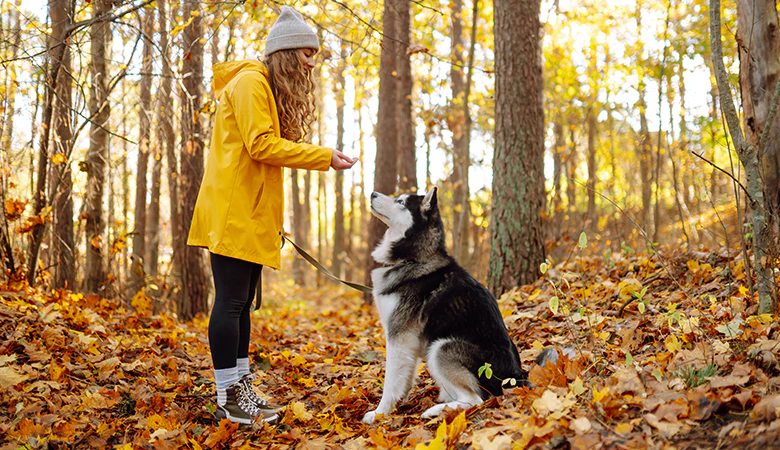
The command “sit” is often the first thing a dog learns. It helps calm your dog in certain situations, for example during greetings or before crossing the road. You can teach this by holding a reward above your dog’s nose and slowly moving it upwards, which causes them to sit automatically.
Down
With the command “down”, your dog learns to lie down. This is useful when you want your dog to stay calm, for example at home or when visitors come over. This is often taught from the sitting position by moving a reward from the nose towards the floor.
Stay
“Stay” helps you keep your dog in one place. This is important for control and safety, for example in busy environments. You teach this by slowly building up the time your dog remains in this position and rewarding them for it. It is also important to gradually build up the distance between you and your dog.
Come/here
The command “come/here” is essential for your dog’s safety. It ensures that your dog always returns to you when you call them. Start practising in a quiet environment and reward your dog immediately when they come to you.
Drop
With “drop”, your dog learns to let something fall from their mouth. This is important when your dog picks up something they should not have. By teaching this command, you can intervene quickly in unwanted situations.
Teaching these dog commands is done step by step. By practising consistently and rewarding desired behaviour, your dog learns to understand better and better what is intended.
Dog commands with hand signals
In addition to spoken instructions, you can also use commands with hand signals. This means linking a movement of your hand or arm to a particular command, so your dog responds not only to your voice but also to visual signals. This can make communication clearer, especially when there are many distractions.
Hand signals for dogs are usually taught in combination with a spoken command. You start by saying the command and making the corresponding signal at the same time. Once your dog understands what is intended, you can gradually place less emphasis on the spoken command and eventually use only the hand signal. There are simple hand signals for many basic commands. For “sit”, for example, you move your hand upwards, for “down” you move your hand towards the floor, and for “come” you make a movement towards yourself. By using these signals consistently, your dog learns the connection between the gesture and the desired behaviour.
Using hand signals can be beneficial in different situations. In a busy or noisy environment, your dog may not hear your voice as well, while a visual signal remains clear. Also, when a dog gets older and their hearing becomes less good, hand signals remain an effective way to give commands.
How do you teach your dog a command?
Teaching a command is done step by step. It is important to start in a quiet environment with few distractions, so your dog can concentrate well. At first, you mainly encourage the desired behaviour. Only once this is going well and your dog shows the behaviour more easily in different places do you add the corresponding command. By saying the command clearly and immediately rewarding desired behaviour, your dog learns more quickly what is expected of them. Reward plays a major role in teaching dog commands. This can be, for example, with a treat or by giving positive attention. By repeating this consistently, your dog learns to make the connection between the command and the behaviour. Eventually, your dog learns what the command means and will also perform the behaviour when you give only the command. It also helps to build up the difficulty slowly. For example, start in your living room and then practise in other places, such as in the garden or during walks. This way, your dog learns to apply the command in different situations. It is also important to let your dog be successful. Do not make the exercises too difficult and build up step by step. By staying patient and training consistently, your dog learns to understand and perform the commands better and better.
Would you like to know more about dog commands, or are you having difficulty teaching your dog a command? Please feel free to contact our veterinary team. You can ask your question by emailing veterinarian@vetsend.co.uk or by sending a message via WhatsApp. This way, you will receive targeted advice that suits your situation and your dog.