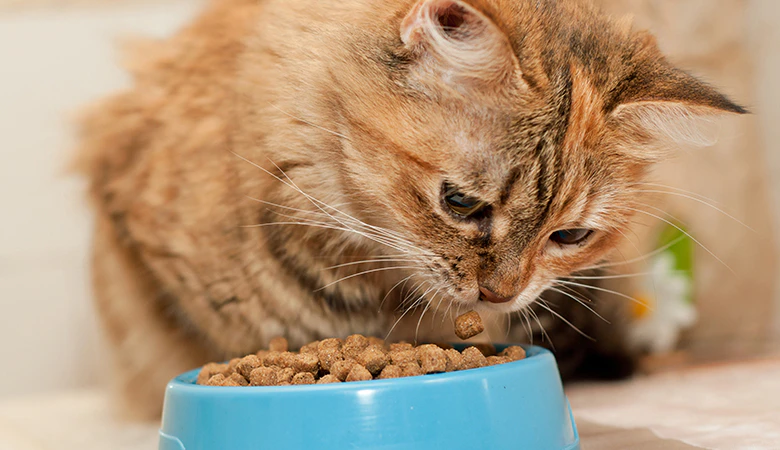
Symptoms of food allergy in cats
In cats, a food allergy manifests itself as itching. The itching is not seasonal. In cats, we mainly see scabs on the skin, symmetrical hair loss, eosinophilic granuloma complex and/or severe itching around the neck and head.
The skin can often become inflamed due to excessive scratching. A food allergy can develop at any age, even if your cat has been eating the same food for years.
How does a food allergy develop in your cat?
An allergic reaction usually develops in response to certain proteins in the food. Carbohydrates can sometimes also trigger a reaction. In cats, allergies to fish, beef, milk and chicken are seen most often.
What food should you give a cat with a food allergy?
The only reliable way to confirm a food allergy in your cat is through an elimination diet. With an elimination diet, you feed your cat a special diet for at least 6 to 8 weeks. This food is made with proteins and preferably also carbohydrates that your cat has never eaten before. A cat can even be fed meat only during this period of 6 to 8 weeks. If you need to continue the diet for longer, it must be supplemented with carbohydrates and/or vitamins and minerals to prevent deficiencies.
There are three ways to give your cat an elimination diet:
- a home-prepared diet
- a ready-made diet based on one novel protein source
- a ready-made diet based on hydrolysed proteins
A home-prepared diet
With a home-prepared diet, you cook for your cat yourself. You usually choose a new meat source, such as horse or rabbit, and a new carbohydrate source, such as rice or pumpkin. Because cats are carnivores, they can even be fed meat only for a period of 6 to 8 weeks. If you want to feed your cat meat for longer, you can supplement the diet with RAW Veterinary Diets – Mono Protein Balancer.
The advantage of a home-prepared diet is that you know exactly what your cat is eating. However, it is more labour-intensive than feeding your cat a ready-made commercial food. You must also pay close attention to hygiene when preparing the meat.
To make things a little easier, you could choose the Unique Protein products from TROVET, for example TROVET Unique Protein UPR (Rabbit) – Dog/Cat.
A ready-made diet with one novel protein source
In addition to cooking for your cat yourself, you can also choose a food with one protein source and one carbohydrate source that your cat has not eaten before. These are commercial diets that contain all the nutrients your cat needs. One example is TROVET Hypoallergenic RRD (Rabbit) Cat.
A ready-made diet with hydrolysed proteins
Finally, you can choose a commercially prepared diet based on hydrolysed proteins. This is also a complete food for your cat. Hydrolysed proteins are proteins that have been broken down into such small fragments that the cat’s body no longer recognises them as proteins and therefore no longer triggers an allergic reaction. There is a difference in the degree of hydrolysis, meaning how small the proteins have been broken down. For an elimination diet, it is important that the proteins are broken down into fragments that are as small as possible. Foods you can choose include Royal Canin Anallergenic Cat, Vetality Hypoallergenic Cat Food or Hill’s z/d Food Sensitivities – Prescription Diet – Feline.
How do you give your cat an elimination diet?
When giving an elimination diet, you must continue it for at least 6 to 8 weeks, and sometimes even longer. During this time, your cat must not eat anything else, so no treats, biscuits or table scraps, and it must not catch mice or birds either. If your cat lives outdoors, it is therefore difficult to follow an elimination diet. You would need to keep your cat indoors for the duration of the diet.
A food allergy is likely if the itching decreases or disappears during the elimination diet. To confirm a food allergy, you must then put your cat back on its old food. If the itching returns, the food allergy is confirmed. In that case, your cat will need to be fed an adapted diet for the rest of its life.
Do you have a question for our veterinarian about food allergy or food hypersensitivity in your cat? Please contact our veterinarian at veterinarian@vetsend.co.uk.