What sleep stages do dogs go through?
A dog does not sleep equally deeply throughout the night or during every nap. Instead, dogs go through different sleep stages that alternate several times. Broadly speaking, these sleep stages can be divided as follows:
- Falling asleep: your dog relaxes and slowly falls asleep. His muscles begin to relax, but sounds or movements in his surroundings can still wake him easily.
- Light sleep: breathing and heart rate become calmer and your dog responds less quickly to his surroundings. However, he is still relatively easy to wake during this stage.
- Deep sleep (non-REM): your dog is completely relaxed and is less likely to wake up because of stimuli in his surroundings. This deep sleep is important for rest and physical recovery.
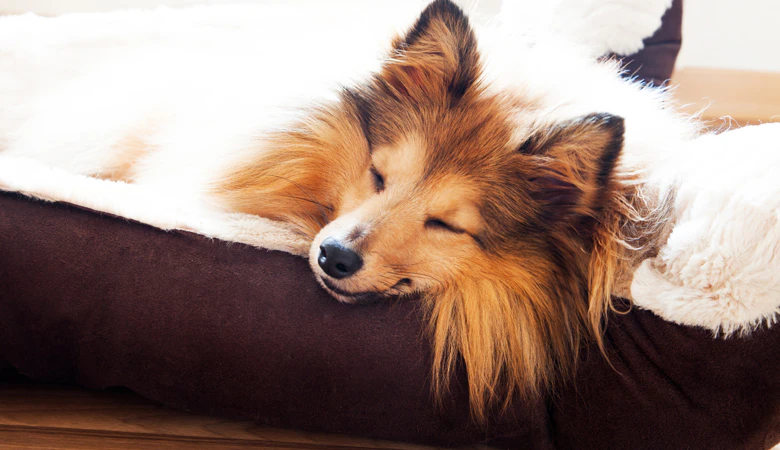
- REM sleep: REM stands for Rapid Eye Movement. During this stage, the brain is relatively active and the eyes may move back and forth beneath the eyelids. You may also see the paws, ears, nose or whiskers move, or hear small sounds. This stage of sleep is particularly strongly associated with dreaming.
These different stages alternate several times during sleep. One moment your dog may be lying completely still and sleeping deeply, while a little later you may see his paws moving or hear a soft bark.
What do dogs dream about?
As fun as it would be to take a look inside your sleeping dog’s mind, we cannot know exactly what he is dreaming about. Events and impressions from everyday life probably play an important role. For example, your dog might dream about a walk through the woods, playing with a ball, running or playing with other dogs, sniffing or discovering new scents, food or treats, and people and animals that are important to him.
Your dog may even dream about you! However, we do not know whether dogs experience their dreams in the same way as humans do. An enthusiastically twitching paw does not automatically mean that your dog is chasing a rabbit in his dream, no matter how much it may look that way. An exact dream interpretation for dogs is therefore not possible.
How can you tell if a dog is dreaming?
A sleeping dog can be quite lively. Especially during REM sleep, you may notice small movements or sounds. Your dog may:
- Move or twitch his paws
- Move his ears
- Twitch his nose or whiskers
- Move his eyes beneath his closed eyelids
- Whimper or whine softly
- Make small barking or growling sounds
- Make licking or chewing movements
- Move his tail
Can dogs have nightmares?
If dogs can dream, it is reasonable to assume that not every dream is pleasant. Dogs process all kinds of impressions and experiences throughout the day, including exciting or unpleasant moments. It is therefore possible that these experiences return during sleep. Does your dog whimper, growl or move restlessly while sleeping? It may look as though he is having a nightmare. However, these signs cannot tell us with certainty what a dog is dreaming about at that moment.
Should you wake a dog when he is dreaming?
Do you see your dog moving or hear him whimpering softly in his sleep? It is usually best to simply let him continue sleeping. Sleep is important, and a dog does not need to be woken up just because he appears to be dreaming. In addition, a dog can be startled if he is suddenly touched while in a deep sleep. In such an unexpected moment, he may react reflexively before fully realising what is happening.
Therefore, teach children to leave a sleeping dog alone. Do you still need to wake your dog, for example because you need to leave? Do so calmly and preferably use your voice rather than touching him unexpectedly.
Do puppies dream more than adult dogs?
Puppies sleep an incredible amount, and that is hardly surprising: growing, playing, exploring and learning all require a lot of energy. Young dogs also have many new impressions to process every day. But puppies are not the only dogs that spend a lot of time sleeping; older dogs often need more rest too. Exactly how much sleep a dog needs varies according to age and individual needs and also depends on factors such as activity level and living environment. It is therefore important that every dog has plenty of opportunities throughout the day to sleep and rest without being disturbed.
Why is a good night’s sleep so important for your dog?
Sleep is about much more than simply resting after a long walk. During sleep, the body has the opportunity to recover and the brain can process information and experiences. A comfortable, quiet place to sleep is therefore important. Ideally, provide a place where your dog feels safe and is not constantly disturbed by people, other pets or noises. Dogs that quickly become excited or overstimulated can particularly benefit from regular periods of rest throughout the day.
And if you suddenly see all four paws moving back and forth during one of those naps? You can only guess what adventure is taking place inside your dog’s mind. Perhaps he is running through the woods, playing with his best canine friend or simply dreaming about that delicious treat he had earlier in the day.