How much should you play with an indoor cat?
There is no set amount of exercise that is suitable for every cat. A young, energetic cat may be ready for a chase several times a day, while an older cat may prefer gentler play. Pay attention to your own cat and their preferences. Several short play sessions spread throughout the day often work better than one long session. Even a few minutes of actively chasing a cat teaser, ball or other toy can provide a fun break during the day. Try to stop the game before your cat completely loses interest. This keeps play interesting and makes it more likely that your cat will be enthusiastic about joining in again next time.
Indoor games for cats
Not every cat enjoys the same things. One cat may enthusiastically chase a ball, while another prefers to watch a cat teaser from a hiding place. By trying different types of games, you can discover what stimulates your cat’s hunting instinct the most.
1. Hunting with a cat teaser
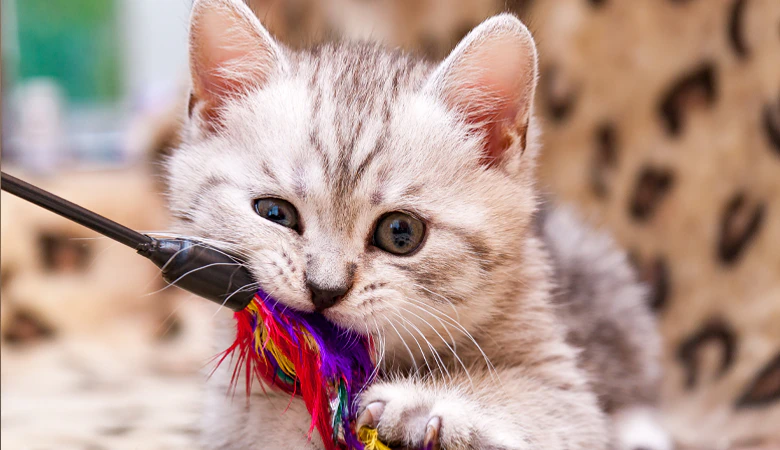
A cat teaser is an easy way to play together with your cat. Rather than constantly moving the toy directly in front of their nose, try to imitate the movements of prey. For example, move it slowly across the floor, let it disappear behind a chair for a moment and then suddenly make it reappear. Alternate slow movements with short, quick movements. Make sure you regularly give your cat the chance to actually catch their ‘prey’ too. Stalking, chasing and eventually catching the prey are what make the game interesting.
2. Hide toys around the house
Turn your living room into a small adventure. Hide a favourite toy behind a chair, under a box or partially underneath a blanket, for example. You can also place toys in different safe locations around the house so that your cat encounters something new during their daily explorations. Change the hiding places regularly. Cats are curious, and even a small change in a familiar environment can spark new interest.
3. Let your cat chase a ball
Balls are ideal for cats that enjoy chasing moving objects. Roll a ball across the floor or down a hallway and see whether your cat gives chase. You can make the game more challenging by rolling the ball alongside furniture or into an empty cardboard box. Some cats find lightweight or rustling balls particularly interesting.
4. Set up a cat tunnel
A play tunnel gives your cat several options at once. Your cat can run through it, hide inside, stalk a toy from the tunnel or simply relax in it. You can move a cat teaser along the outside of the tunnel or roll a ball through it. This combines hiding and hunting in one game.
5. Let your cat work for their food
Food does not always have to be served directly in a food bowl. With a food puzzle or fillable cat toy, your cat has to make an effort to reach their kibble or treats. This not only encourages movement but also provides mental stimulation. Start with a simple puzzle so your cat understands what to do. Once they can solve it easily, you can move on to a more difficult version.
You can also hide part of your cat’s daily portion of kibble in different places around the house. This encourages your cat to use their nose and curiosity to find their meal. Make sure that any kibble and treats you use during play are included in their daily food allowance. This prevents extra play and feeding sessions from unintentionally adding too many extra calories.
6. Use boxes and paper
A toy does not have to be complicated. For some cats, a sturdy cardboard box can be just as interesting as a specially designed toy. For example, make several openings in a box and move a toy past the openings. Your cat can try to catch it with their paw. Several boxes placed next to each other can also create a fun place to hide and explore. Always check homemade toys for loose parts, staples, strings or other materials that your cat could swallow.
7. Rotate your cat’s toys
Does your cat have a whole basket full of toys but barely pays attention to them anymore? This does not necessarily mean they no longer like the toys. When the same toys are always available, they can lose their appeal. Put some of them away and rotate the toys regularly. A toy mouse that has been out of sight for a while may suddenly become very interesting again.
Encourage natural hunting behaviour
A good cat game often resembles a small hunt. A cat first observes, then stalks closer, starts the chase and eventually tries to catch their prey. You can take this into account during play. A toy that is constantly waved wildly in front of your cat’s face will not appeal to every cat. Instead, let a cat teaser or toy mouse disappear occasionally before making it reappear.
Do not forget the final step either: regularly allow your cat to catch the toy. This makes the game more satisfying.
Do you use a laser pointer? A laser can encourage lots of movement, but your cat cannot actually catch the light. It is therefore best to finish the game with a physical toy or a small piece of food that your cat can actually catch.
Climbing and scratching are part of exercise too
Exercise means more to a cat than simply running around. Cats climb, jump, stretch and scratch. Especially for indoor cats, it is therefore important to provide plenty of opportunities to move vertically too.
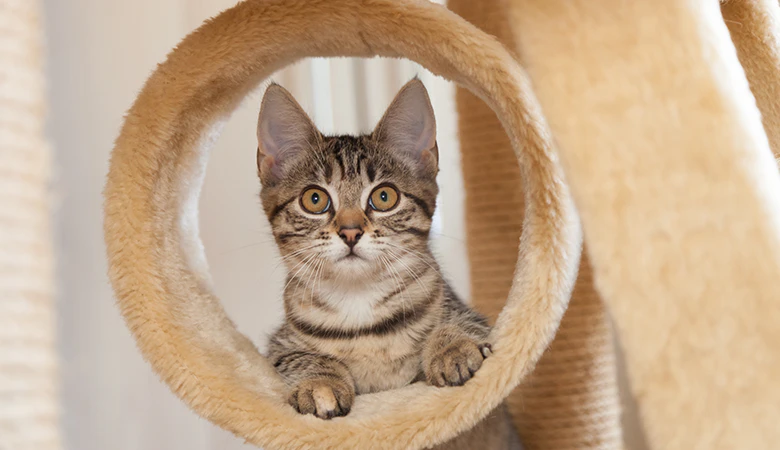
A tall scratching post or scratching furniture can provide a climbing area, lookout point and scratching surface all at once. Many cats enjoy observing their surroundings from a higher position. Do you have limited floor space? Sturdy wall shelves or other safe elevated resting places can also be useful. Always make sure that any structure is stable and that your cat can safely climb up and down.
Make your home an interesting environment for your cat
You do not need to actively entertain your cat all the time. A well-designed home can also encourage your cat to move around and explore independently. For example, avoid placing all important resources directly next to each other. If your cat has to walk to different areas of the house for food, water, the litter tray, their favourite sleeping place and scratching area, they will naturally get more exercise. A safe spot by a window can also be interesting. People walking past, birds and movement outdoors provide plenty to watch. If you have an open window or balcony, always make sure your cat cannot escape or fall.
In our range of everyday cat supplies, you will find cat toys, scratching posts and furniture, beds, food and water bowls and other products that can help enrich your indoor cat’s living environment.
Indoor activities for cats that get bored easily
Some cats need more stimulation than others. Young and active cats in particular can quickly lose interest in a predictable game. If this happens, try changing things regularly. Move a tunnel, create a new obstacle course using boxes, hide kibble in different places or introduce a new food puzzle. You do not need to buy new toys every week. Simply presenting existing toys in a different way and rotating them can be enough to spark your cat’s interest again.
Playing together also remains important. Interactive toys where you control how the ‘prey’ moves are much less predictable than toys that always behave in the same way.
My cat doesn’t want to play – what should I do?
Not every cat will immediately jump enthusiastically after a toy. Try different types of movements and toys. Some cats respond particularly well to feathers, while others prefer rustling sounds, balls or toys that move across the floor. The time of day can also make a difference. Cats are often more active in the morning and evening, so try playing at different times of the day.
Also take your cat’s age and physical condition into account. A senior cat can still get plenty of enjoyment from playing but may prefer gentler games that do not require them to jump as high.
Has your cat suddenly stopped wanting to play even though they are normally active? Or have you noticed that they are eating less, withdrawing, walking stiffly, having difficulty jumping or showing other unusual behaviour? There may be more going on than boredom. In this case, have your cat checked by a vet.
Playing with an overweight cat
Exercise is particularly important if your cat is overweight, but activity should be increased gradually. An overweight cat does not need to suddenly spend long periods chasing a cat teaser. Start with short play sessions and encourage a little extra movement several times a day. For example, encourage your cat to walk a few metres after a toy or use a food puzzle that gets them more actively involved with their meal.
However, weight loss is not just about exercise. Diet and total daily energy intake also play an important role. Is your cat clearly overweight? Discuss a suitable target weight and weight-loss plan with your vet.
Don’t forget about rest
An active indoor cat also needs plenty of rest. Cats sleep and doze for a large part of the day. This is normal behaviour and does not necessarily mean your cat is bored. Alongside sufficient stimulation, make sure your cat also has quiet, comfortable sleeping places where they can retreat. Especially in a household with children or multiple pets, it is important that your cat can choose between activity and rest.
How to make indoor life fun
An indoor cat certainly does not have to be bored. By alternating exercise, hunting games, climbing, scratching, food enrichment and rest, you give your cat the opportunity to express a range of natural behaviours. Pay particular attention to what your own cat enjoys. One cat may love a cat teaser, while another prefers solving a food puzzle or stalking a ball from inside a tunnel. Regular variation keeps the environment interesting. With a few short play sessions each day and a stimulating home environment, you can do a lot to keep your indoor cat both physically and mentally active.