Service
Basket
Menu
Weekend deal: Get 25% off Vetality in the Medpets app Read more

Boa Constrictor

The Boa Constrictor is a large constrictor snake that naturally occurs in Central and South America, where it lives in tropical forests, savannas and other warm, humid regions. This snake is mainly active at dusk and during the night and spends a lot of time on the ground, but it also regularly climbs into shrubs and trees, especially when young. Boa Constrictors are known for their calm and confident temperament and are generally easy to handle when handled consistently and calmly. In captivity, it is important to replicate the natural living conditions as closely as possible, with appropriate temperatures, suitable humidity levels and a well designed terrarium. This helps support good overall condition and prevents unnecessary stress.

Boa Constrictor

Characteristics

Country of origin: Central and South America
Also known as: Common boa
Body build: Very robust, muscular body with a broad head and powerful jaw muscles.
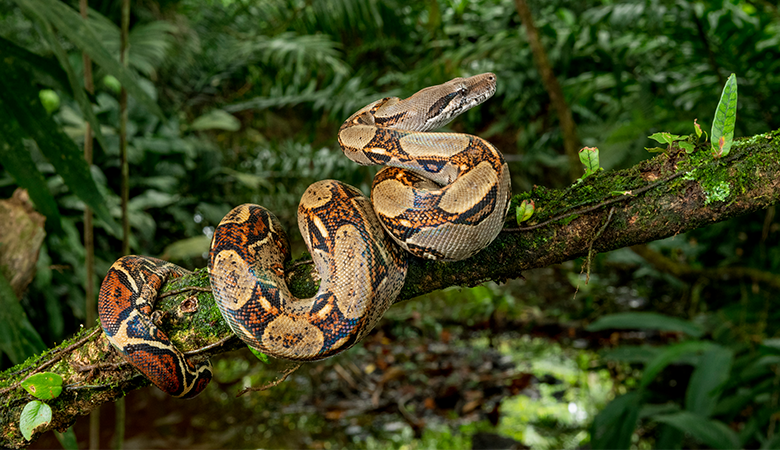
Colours and coat types: Smooth scales with a striking pattern. The base colour ranges from grey and brown to reddish, with dark saddle-shaped markings. In captivity, various colour and pattern variants occur.
Weight: 10 - 25 kg
Life Expectancy: 20 - 30 years
Health risks: Respiratory infections, shedding problems, parasites, and issues caused by incorrect temperature or humidity.

Profile

Activity
Tameness
Ease of care
Space requirements
Environmental sensitivity
Nutritional needs

Popular products for the Boa Constrictor

Origin

The Boa Constrictor naturally occurs in large parts of Central and South America. There it lives in tropical rainforests, savannas and other warm regions with relatively high humidity. The Boa Constrictor is mainly active at dusk and during the night and spends a large part of the day in sheltered places, such as among tree roots, under vegetation or in abandoned burrows. Its way of life is adapted to a warm climate with limited temperature fluctuations. Thanks to its strong muscles and efficient metabolism, it can go without food for long periods and adapt to the changing conditions within its habitat.

Appearance and behaviour

The Boa Constrictor has a powerful, muscular body and a broad head with clearly defined jaw muscles. Its skin consists of smooth scales with a distinct pattern, with the base colour ranging from grey and brown to reddish, with dark markings along the back. In captivity, various colour and pattern variants occur. Boa Constrictors are generally calm snakes that spend most of their time resting, but become more active especially at dusk. They are not strong climbers, although younger animals use height more often. When disturbed, a boa may react defensively by hissing or coiling tightly, but when handled calmly and consistently, they are generally easy to handle. The Boa Constrictor sheds its skin regularly and usually leaves it behind in one complete piece. Appropriate humidity levels and sufficient hiding places support a smooth shedding process.

All about the Boa Constrictor

What does a Boa Constrictor eat?

The Boa Constrictor is a carnivore that feeds on various prey animals in the wild, such as rodents, birds and occasionally larger mammals, depending on its size. The prey is seized and killed by constriction before being swallowed whole.

In captivity, a suitable diet consists of thawed frozen prey such as mice or rats, adjusted to the size and age of the snake. Young boas are given smaller prey and are fed more frequently, while adult animals receive larger prey at longer intervals, usually about once every 3 to 4 weeks. Feeding live prey is not recommended due to the risk of injury. In addition, make sure that the prey animals are fully thawed and at the correct temperature before offering them. Fresh, clean drinking water should always be available.

Is a Boa Constrictor dangerous?

A Boa Constrictor is not venomous, but due to its size and strength it can pose certain risks. To humans, it is generally not dangerous as long as it is kept responsibly and handled correctly. Boa Constrictors are constrictor snakes and use their muscle strength to kill prey. A bite or tightly constricting an arm can be painful, especially with larger snakes. Therefore, it is important to always handle the snake calmly and, with larger specimens, preferably not alone. With experience, proper housing and respect for the animal, the Boa Constrictor is generally manageable to keep.

What is the difference between a Boa and a Python?

Boas and pythons are both large constrictor snakes, but they differ in several important ways. One difference lies in reproduction: boas, such as the Boa Constrictor, give birth to live young, while pythons lay eggs and guard them by coiling around them. There are also physical differences. Boas usually have a sturdier, more compact body and a shorter, less distinct neck. Pythons are often longer and slimmer and have a more clearly defined head. In addition, pythons have heat-sensitive pits along the lips that they use to detect prey. In boas, these are absent or less developed. Finally, their distribution differs: boas mainly occur in Central and South America, while pythons primarily live in Africa, Asia and Australia.

How big or long does a Boa Constrictor grow?

An adult Boa Constrictor reaches an average length of 200 to 300 cm. Some individuals can grow even larger and exceed 3 metres in length, especially females. The final size depends on factors such as sex, genetic background, diet and housing. Boa Constrictors continue to grow for several years and usually only reach their adult size after 5 to 7 years.

Can a Boa Constrictor bite?

Yes, a Boa Constrictor can bite, but this usually only happens as a defensive reaction when the animal is startled, feels threatened or is handled incorrectly. Boa Constrictors are not aggressive snakes and usually try to avoid confrontation. If a Boa Constrictor does bite, the bite is not venomous, but can be painful due to the sharp, backward-facing teeth and may cause small wounds. By approaching the snake calmly, avoiding sudden movements and taking its behaviour into account, biting rarely occurs in practice.

Care and housing of the Boa Constrictor

The Boa Constrictor is a large, heavy snake that spends most of its time on the ground. For an adult animal, a spacious and sturdy terrarium is essential, with the minimum dimensions depending on the snake’s final length. As a guideline, the terrarium should be at least as long as the snake itself, with sufficient depth and height to allow natural behaviour. A well secured enclosure is important, as Boa Constrictors are powerful and can escape if the terrarium is not robust. When setting up the enclosure, ensure a clearly defined warm and cooler zone and provide multiple hiding places so the snake can retreat safely.

Temperature and lighting

On the warm side of the terrarium, the ideal temperature ranges between 28 and 32°C, with a warm spot of around 32°C. The cooler side may remain at approximately 24 to 26°C. At night, the temperature may drop slightly, but not below 22°C. Lighting is generally provided for 10 to 12 hours per day to support a stable day and night rhythm. UVB lighting is not strictly necessary. Always use a reliable thermostat to properly regulate temperature differences.

Setup

Choose a substrate that retains moisture while remaining hygienic, such as coconut fibre, beech chips or bark. Place several sturdy hides that are large enough to support the weight of the snake. Branches and platforms can be added, especially for younger animals, but must always be securely fixed. A large, stable water dish with fresh water is essential and should be big enough for the snake to soak in if desired. Replace the water and clean the dish regularly to prevent bacterial growth.

Care

Boa Constrictors shed their skin regularly and usually leave it behind in one complete piece. A sufficiently high humidity level is important to prevent shedding problems. After shedding, check whether the skin has been fully removed, especially around the tip of the tail. Daily removal of faeces, refreshing the drinking water and keeping the terrarium clean all contribute to good hygiene. In addition, it is important to regularly monitor the snake’s body condition, as overweight can occur in large snakes.

More tips