Service
Basket
Menu
Save up to 30% now on Royal Canin Read more

Cat brings mice indoors: what you can do

Written by Meanne |

A mouse on the doormat or a bird in the living room is a familiar situation for many cat owners with an outdoor cat. Although this can be unwanted, this hunting behaviour is completely natural for cats. Even cats that get enough food every day can still go hunting and bring their catch home. But why do cats bring prey indoors? And is there anything you can do to prevent a caught mouse or bird from ending up inside your home? In this blog, you can read more about cats’ hunting instincts, why they take their prey to a safe place and what options there are to reduce unwanted prey in the home.
Cat brings mice indoors

Hunting is natural cat behaviour

Even though cats are fed every day, the hunting instinct is still deeply rooted in their behaviour. Cats descend from ancestors that had to hunt to survive. As a result, many traits that make them good hunters are still present. Think of their sharp senses, quick reactions and ability to stalk prey silently. Hunting is also not only a way to obtain food. Seeing a moving object, such as a mouse or bird, can already activate a cat’s natural hunting instinct. This means that even cats that get enough to eat may actively hunt when the opportunity arises.

Cats learn their hunting skills from a young age. While playing with their mother, brothers and sisters, they practise behaviour that will be useful later during hunting, such as stalking, pouncing and catching. Although not every cat hunts with the same enthusiasm, the hunting instinct remains present in both indoor and outdoor cats.

Popular products

Why cats bring prey home

Many cat owners wonder why their cat brings a caught mouse, bird or other prey animal home. Although it is often thought that cats offer their catch as a gift, behaviour experts believe there is another explanation. Cats are naturally solitary hunters. When a cat catches prey, it will often take it to a place where it feels safe. For domestic cats, this is usually their home environment. In the wild, cats would eat their prey in a safe location. Because domestic cats generally receive sufficient food, it is quite common for a caught prey animal not to be eaten and instead be left in or around the home.

Mice and birds are among the most common prey animals for cats, but some cats also catch rats, frogs, lizards and other small animals. Which prey animals a cat catches depends on factors such as its environment, the animals available and how strongly its hunting behaviour is developed. Although not every cat is equally successful at hunting, bringing prey home remains a natural part of behaviour for many outdoor cats. It is therefore not unusual for a cat to occasionally appear at the door, or even in the living room, with an unexpected catch.

Can you stop your cat from bringing prey indoors?

Because hunting is a natural instinct, you cannot completely train a cat out of this behaviour. However, there are several ways to reduce the likelihood of successful hunts or bringing prey home. Regular play can help stimulate a cat’s hunting instinct in a different way. Toys that move, such as a teaser wand or other interactive cat toys, provide mental stimulation and allow cats to display natural hunting behaviour during play.

Some cat owners choose to let their cat wear a collar with a bell. The sound can warn prey animals, giving them a chance to escape before the cat gets close enough. It may also help to keep your cat indoors during times when prey animals are most active, such as around sunrise and sunset. In addition, it is important to provide your cat with a complete and balanced diet. Although cats do not hunt solely because they are hungry, a good feeding routine can contribute to their overall wellbeing and daily activity levels.

These measures may help reduce the number of prey animals caught, but they do not guarantee success. Cats are hunters by nature and may still catch a mouse, bird or other small animal despite all precautions. For cat owners who want to prevent prey animals from entering the home through the cat flap, technological solutions are now also available.

A smart solution with AI

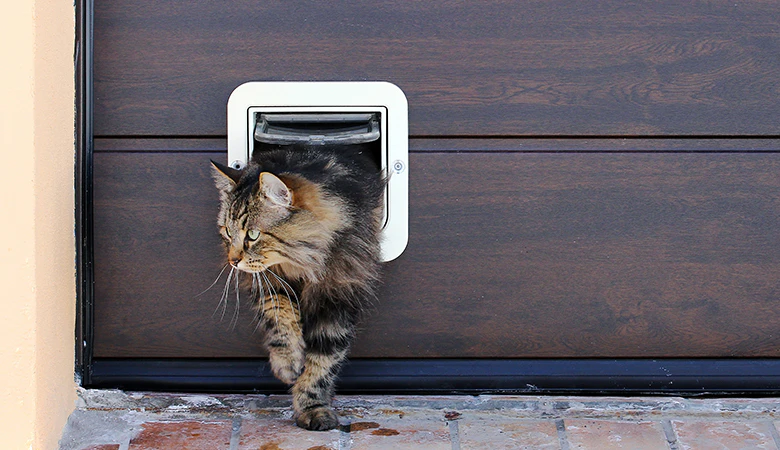
Because hunting is a natural part of feline behaviour, it is not always possible to prevent a cat from catching prey. Smart cat flap extensions with AI technology therefore focus not on stopping hunting behaviour, but on preventing caught prey animals from entering the home through the cat flap. These systems use a camera and AI image recognition to check whether a cat has prey in its mouth when approaching the cat flap. As soon as the cat comes near the flap, a motion sensor detects the activity. The camera then takes several photographs of the cat, which are analysed to determine whether it is carrying prey. If no prey is detected, the cat flap opens as normal. If the system recognises a prey animal, the cat flap remains closed. This allows the cat to continue going outdoors and displaying its natural behaviour, while reducing the likelihood of a caught mouse, bird or other small animal entering the home.

Sign up for our newsletter

Also read our other blogs

More tips