Dementia and brain ageing in dogs and cats
Written by |
Ailments come with age, and our four-legged friends are no exception. They may become a little hard of hearing, their eyesight is not what it used to be, they grow a bit stiffer, and other niggles can crop up.
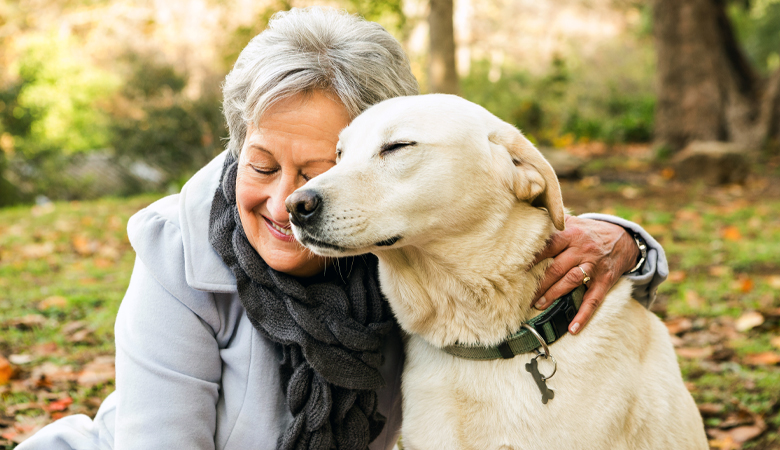
Also, like people, animals can experience mental decline as they grow older. This is often a gradual process. It starts with mild behavioural changes that worsen over time. In people we speak of dementia, while in animals the official term is Cognitive Dysfunction Syndrome (CDS).
Symptoms
The symptoms of CDS vary, but they often resemble those seen in people with dementia. They are especially noticeable in dogs, less so in cats. This is probably because cats naturally sleep more and often live outside their owner’s line of sight. Dogs usually have a closer bond with their owner and have learned many behaviours and commands over their lifetime. This makes it very noticeable when a dog starts forgetting things that used to come naturally.
Dogs and cats may begin to show signs of disorientation. They no longer know where they are or wander aimlessly through the house. It also happens that dogs forget where they live and, after a walk, pass straight by their home. Another typical complaint is that the dog forgets which side a door opens on and sits waiting on the hinge side.
As in people, animals with dementia develop memory loss and a reduced ability to learn. Commands that were always carried out well are suddenly forgotten. Teaching your dog something new becomes harder and slower, and sometimes it does not work at all.
The day and night rhythm is often disrupted. Where the dog or cat used to be active during the day and slept at night, this is often reversed with dementia. Dogs and cats may suddenly roam the house at night and start howling or meowing plaintively.
Animals with dementia may behave differently towards their owner or other animals. Sometimes interest in social contact increases, but it can also decrease. It also happens that members of the household are greeted less enthusiastically.
Dogs with dementia can become unhouse-trained, as if they forget their house-training. Cats may struggle to find the litter tray. Both dogs and cats may deliberately urinate and defecate indoors, even right after a walk.
Due to dementia, an animal may show increased anxiety, aggression or restlessness. Dogs may bark more, including at inappropriate times. Sometimes separation anxiety develops, or fear of, for example, fireworks, which did not exist before.
Diagnosis
Because the symptoms vary so much, the diagnosis is difficult to make. In people, the diagnosis can be made using medical history, family history and clinical examination. During this examination, several tests are performed in which the person’s memory is assessed using questions and small tasks. In animals, the diagnosis often relies only on ruling out other physical causes. After all, we cannot ask a dog whether it still remembers what it ate yesterday.
It is therefore important to have your animal examined for other diseases or conditions first. Pain or an illness that makes an animal feel unwell can also cause behavioural changes.
Treatment
There is no curative therapy for dementia in dogs and cats. However, mental decline can be slowed by various measures.
First, it involves a degree of understanding on your part as the owner. If you understand what is going on with your dog or cat, you can take it into account as much as possible. Routine is important for an animal with dementia. Walk your dog at set times and feed your pet at fixed times. Reward your animal when it shows desired behaviour, but stop all forms of punishment. This increases stress, and the dog often no longer knows what it did wrong. Make sure your dog stays physically active. This is good for fitness and circulation and stimulates brain activity. It also helps tire your dog during the day, so that it hopefully sleeps better at night. Brain games also help delay the onset of signs of dementia. You can try teaching new commands or doing small exercises with your dog. Puzzle toys can also help keep your dog’s or cat’s brain active.
To reduce stress, pheromone products can be used. Adaptil for dogs and Feliway for cats. The pheromones have a calming effect and can help bring calm in a confusing situation.
Nutrition
Hill’s has developed a diet specifically for dogs with behavioural changes associated with dementia: b/d Ageing & Alertness. The diet contains a special mix of antioxidants and vegetables to counter symptoms of brain ageing and age-related behavioural changes. It also helps improve the learning ability of older dogs.
Food supplements
In addition to these measures, various food supplements can be given to support the brain. Research has shown that antioxidants, omega-3 fatty acids and certain amino acids can have a positive effect in animals with signs of dementia.
Antioxidants
Because free radicals play a role in the development of dementia in dogs and cats, a food supplement with antioxidants can help improve brain function. An example of such a supplement is Aktivait for dogs and for cats. In addition to antioxidants, the supplements also contain omega-3 fatty acids.
Omega-3 fatty acids
Omega-3 fatty acids are converted in the body into various beneficial substances, including eicosapentaenoic acid (EPA) and docosahexaenoic acid (DHA). DHA protects the body against so-called free radicals, the deposits of which in the brain are thought to be one of the possible causes of dementia.
Choline
Choline is an example of a semi-essential nutrient that can be used safely and with rapid effect in cognitive dysfunction. ‘Semi-essential’ means that a healthy body is able to produce sufficient choline itself. However, certain essential amino acids are needed for this. When these amino acids are provided too little in the diet, but especially when they are insufficiently absorbed by the body as a result of ageing, a lack of choline can lead to problems with cognition.
Choline is one of the few organic substances that can cross the blood-brain barrier. It is indispensable for the formation of the neurotransmitter acetylcholine. This neurotransmitter is very important for the brain; it ensures healthy signal transmission in the nervous system. Human research has shown that people with Alzheimer’s have a strongly reduced level of acetylcholine. In animals that show signs of early dementia, administering a high dose of choline can slow this process and in many cases help the animal get back on its feet.
Cholodin is an example of a supplement for dogs and cats that contains a high dose of choline. It also contains phosphatidylcholine, an important component of cell membranes, and the essential amino acid methionine. It also contains inositol, a vitamin-like substance that has a calming effect and a beneficial effect on blood pressure. Various clinical studies have demonstrated the positive effects of Cholodin in the most common symptoms of dementia, and experience shows that supplementing choline often produces particularly rapid results in both dogs and cats.
Have a question for our veterinarian about dementia or brain ageing or age-related complaints in pets in general? Please contact our veterinarian via Whatsapp (0031 – 850 871 297) or by email: veterinarian@vetsend.co.uk.