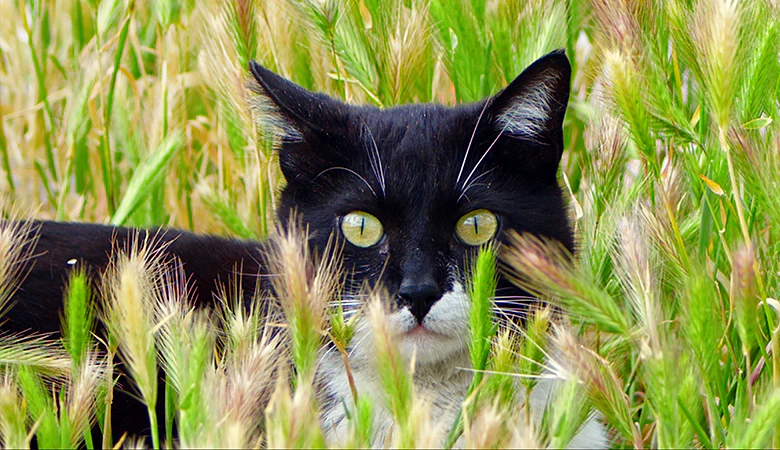
When do grass awns occur?
Grass awns mainly occur from late spring to the end of summer. The highest risk period is usually between June and September.
You often find them in tall grass, along footpaths, on verges, on wasteland and in meadows.
How does a cat get a grass awn?
Cats usually pick up a grass awn while roaming through tall grass or bushes. The awn can:
- get caught in the coat
- end up between the toes
- enter the ear
- be inhaled through the nose
- in exceptional cases, enter via the eyes
Due to the barbs, the grass awn works its way further inwards.
Symptoms of a grass awn in cats
The symptoms depend on where the grass awn is located.
Grass awn between the toes
A grass awn between the toes can cause:
- limping
- excessive licking of a paw
- redness
- swelling
- a painful small wound between the toes
Sometimes a small hole develops from which fluid or pus comes out.
Grass awn in the ear
A grass awn in the ear often causes:
- sudden, vigorous head shaking
- scratching at the ear
- holding the head at an angle
- pain when the ear is touched
Grass awn in the nose
If a grass awn gets into the nose, cats may experience:
- sneezing
- sudden sneezing fits
- nasal discharge
- bloody nasal discharge
- rubbing the nose with the paw
Grass awn in the eye
A grass awn in or around the eye can lead to:
- squinting
- watery eyes
- redness
- eye inflammation
Why are grass awns dangerous?
A grass awn usually does not stay in place on its own. Due to the barbs, it can penetrate further and further into the body.
This can lead to problems such as abscesses, inflammation, fistulas and wounds that do not heal. In rare cases, grass awns can move deep through tissues, making it difficult to find the cause of the symptoms.
What should you do if you suspect a grass awn?
If you suspect that your cat has a grass awn, it is sensible to contact the vet. Do not try to remove a deeply embedded grass awn yourself. This can cause the awn to break, leaving part of it behind and still causing problems. The vet can locate the grass awn and remove it safely. Sometimes light sedation is needed, especially when the grass awn is in the ear, nose or deep between the toes.
How can you help prevent grass awns in cats?
Grass awns cannot always be prevented, but you can reduce the risk.
- Check your cat regularly: Ideally, check your cat after every walk or outdoor adventure. Pay particular attention between the toes, around the ears, around the eyes, in the armpits and under the tail
- Take good care of the coat: In long-haired cats, grass awns can more easily remain unnoticed. Regular brushing helps you discover them in time.
- Pay attention to risk areas: Try to keep cats away from areas with lots of dry, tall grass as much as possible during the summer months.
When should you go straight to the vet?
Contact your vet if your cat:
- suddenly starts limping
- licks a paw a lot
- sneezes intensely
- has bloody nasal discharge
- shakes its head
- develops painful swellings or wounds
The sooner a grass awn is removed, the lower the risk of complications.
Do you have any questions about grass awns in cats? Please contact us via veterinarian@vetsend.co.uk.