Service
Basket
Menu
Up to 20% off Hill's products! Read more

How old does a turtle get?

Written by Meanne |

Turtles are known for their calm nature, slow movements and impressive lifespan. While some species can live for several decades, others can even approach one hundred years of age. However, the age a turtle can reach varies greatly depending on the species and its way of life. Tortoises generally live significantly longer than aquatic turtles, partly because of their diet and environment. In this blog, you can read about the life expectancy of different turtles and which factors influence it.

How old does a turtle get?

Different types of turtles

Worldwide, there are around 350 different turtle species, which can roughly be divided into tortoises, freshwater turtles and sea turtles. Although they share many similarities, they differ greatly in habitat, diet and life expectancy.

Tortoises

As the name suggests, tortoises live exclusively on land. They occur in different climates and, depending on the species, can be found in dry desert regions, open steppes or densely vegetated forests. They mainly eat plant-based food such as grasses, leaves and vegetables. Thanks to their slow metabolism and calm lifestyle, they can often go for a long time without food or water. An environment with enough warmth and hiding places is essential for their wellbeing. Tortoises can become remarkably old. Many species reach an age of 50 to 80 years, with some individuals living to 100 years or more.

Aquatic and marsh turtles

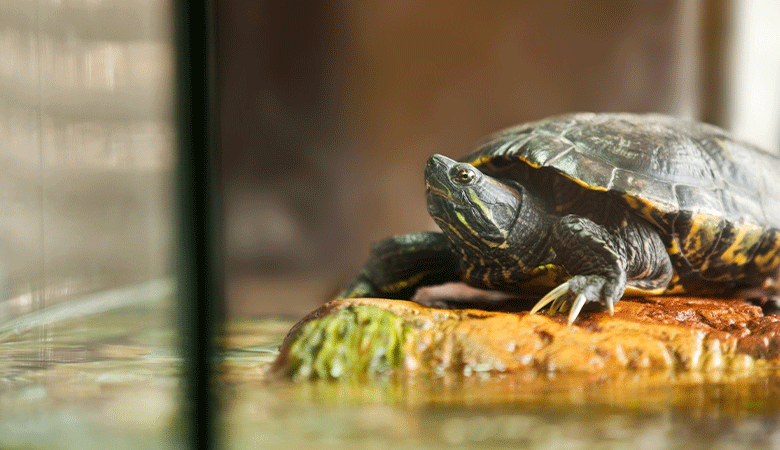
Aquatic and marsh turtles live in freshwater areas such as ponds, lakes, rivers and marshes. They spend a lot of time in the water but regularly come onto land to bask. Their diet consists of a mix of plant-based and animal-based food, such as aquatic plants, insects and small fish. They are generally more active than tortoises and need clean water, enough space to swim and a land area. This balance in their habitat is important for their health. Aquatic and marsh turtles live on average between 20 and 40 years.

Sea turtles

Sea turtles live exclusively in the ocean and only come onto land to lay eggs. Worldwide, seven species are known, which mainly occur in tropical and subtropical regions. Their diet differs per species, but in general they eat algae, jellyfish or shellfish. Sea turtles are excellent swimmers that travel over enormous distances, often between their feeding grounds and nesting beaches. Unlike tortoises and freshwater turtles, they are not kept as pets, but they are important for the marine ecosystem. Sea turtles can reach an impressive age of 60 to 100 years.
Products for turtles

Life expectancy of the most commonly kept turtles

Although turtles in the wild can reach an impressive age, this is not guaranteed for turtles that are kept as pets. Their lifespan depends heavily on how they are housed and cared for. A well set up enclosure, the right temperature and lighting, clean water and a balanced diet all play a role in how old a turtle can eventually become. If it feels comfortable in its environment, this reduces the risk of stress and health problems and increases the chance of a long and healthy life. Good care is therefore important not only for life expectancy but also for the animal’s wellbeing.

Life expectancy also depends on the species of turtle that is kept. In Europe, the red-eared slider, yellow-eared slider, yellow-bellied slider, Greek tortoise and four-toed tortoise are among the most commonly kept species. Each of these turtles has its own way of life, care requirements and average life expectancy. For example, the red-eared slider can on average reach 30 to 40 years, as long as it lives in clean, well heated water and receives enough sunlight or UV light. The yellow-eared slider often reaches a similar age, provided the water temperature remains stable and there is enough space to swim and bask. The yellow-bellied slider can also live 30 to 40 years if it is given a varied diet and its enclosure is maintained regularly. The Greek tortoise can live considerably longer, often 60 to 80 years, with some individuals reaching 100 years or more, as long as it has access to a spacious outdoor area with enough warmth and can have a proper winter rest every year. The four-toed tortoise has an average life expectancy of 50 to 70 years if it lives in a dry and well ventilated enclosure and is given a controlled winter rest each year.

More blogs about reptiles

Slang op tak

What does a snake eat?

Snakes have specific dietary needs that are closely linked to their way of life and hunting behaviour. In the wild they hunt a range of prey, from insects and rodents to birds, eggs and even other reptiles. Because snakes are cold-blooded animals, they eat less frequently than many other species. Their metabolism is slower and they can store energy efficiently. When a snake is kept as a pet, it is important to match its diet as closely as possible to its natural feeding pattern. In this blog you will learn what snakes eat in the wild, which foods are suitable for pet snakes, and what they should not be fed.

reptile

Types of reptiles: which reptiles are there?

Reptiles are fascinating animals that have been roaming our planet for millions of years. They belong to the group of cold-blooded vertebrates, have scaly skin, usually lay eggs, and depend on their environment to regulate their body temperature. Reptiles are popular as pets, but they are also incredibly diverse in the wild. In this blog, you will learn which types of reptiles exist and what their main characteristics are.

What does a turtle eat?

What does a turtle eat?

Turtles have specific nutritional needs that are crucial for their health and lifespan. A well-balanced diet prevents deficiencies, supports the growth of the shell and helps to avoid common disorders. What a turtle needs depends on the species: tortoises mainly eat plant-based food, while aquatic and marsh turtles also need animal-based food. In this blog, you can read what different types of turtles need and how you can adapt their diet to their way of life.

More tips