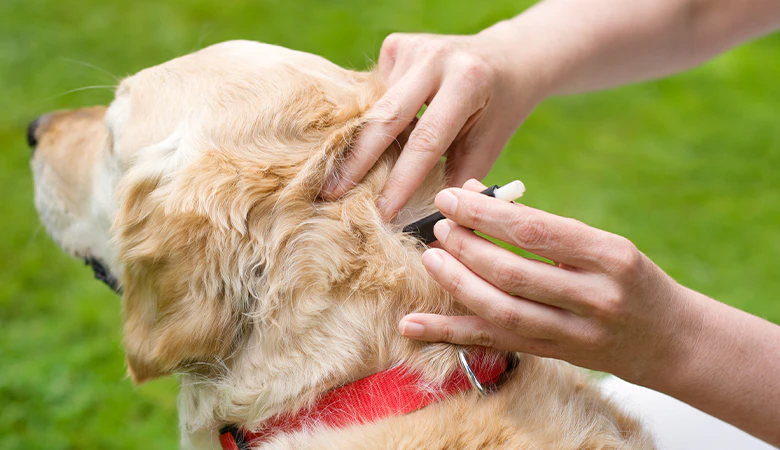
How quickly should you remove a tick from a dog?
The sooner you remove a tick, the better. The advice is: remove a tick as quickly as possible, preferably within 24 hours. The longer a tick remains attached, the greater the chance of transmitting pathogens. Therefore, check your dog daily after walks in woodland or tall grass. Pay particular attention to areas with thinner hair, such as around the ears, in the groin and armpits, and between the toes.
How can you tell how long a tick has been feeding on blood?
How long a tick has been attached to your dog can often be estimated to some extent from the size of the tick:
- a small, flat tick has usually only been attached for a short time
- a large, grey or swollen tick has often been feeding for longer
A fully engorged tick may have been on the dog for several days. Even so, it remains difficult to determine exactly how long a tick has been present.
Tip: Always write down in your diary when you removed a tick from your dog. If your dog then becomes ill, you can mention this to your veterinarian.
What should you do if the head of the tick has remained behind?
Sometimes a small part of the tick’s mouthparts remains in the skin. This looks like a small black dot. In most cases this is not dangerous. The body will often push it out by itself, just like a splinter.
What you should definitely not do is try to pick the head out with tweezers or scratch it out with your nail.
What you should do:
- keep the area clean
- disinfect the skin
- check for redness, swelling or inflammation
Go to the veterinarian if:
- the skin becomes very thick or red
- pus develops
- your dog keeps scratching or licking the area a lot
What if a dog will not let you remove a tick?
Some dogs find tick removal frightening or painful. What can you do if a dog will not let you remove a tick?
Try to:
- stay calm
- distract your dog with a tasty treat
- have someone else hold the dog
- take short breaks
Is it really not possible to do it safely? Then contact the veterinarian. Help may be wise especially for ticks in sensitive places, such as around the eyes, in the ears or between the toes.
How can you prevent ticks in dogs?
Prevention is of course better than removal. Fortunately, there are several products that protect dogs against ticks.
View all products against fleas and ticks in dogs here.
Well-known products include:
- Frontpro (tablet)
- Vectra 3D (pipette)
- Scalibor Protectorband (tick collar)
- Seresto (flea and tick collar)
Read our blog ‘The best treatment for fleas and ticks in dogs‘ to determine the best way to protect your dog.
Check your dog regularly
Even when you use preventative products, checking remains important. No product offers a 100% guarantee. Therefore, continue to check your dog daily for ticks. Especially after:
- walks in nature
- playing in tall grass
- visits to the woods
The sooner you spot and remove a tick, the smaller the risk of problems.
Do you have questions about removing a tick from your dog? Please contact us via veterinarian@vetsend.co.uk.