Service
Basket
Menu
Up to 20% off festive favourites for your pet and more! Read more

Green Iguana

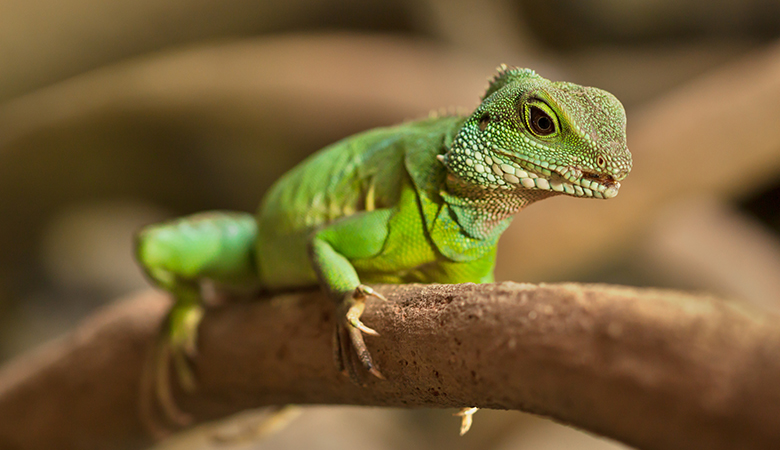
The Green Iguana (Iguana Iguana) is a large, tree-dwelling lizard that naturally occurs in the tropical rainforests of Central and South America. This reptile species mainly lives high up in the trees, often near water, and is active during the day. Green iguanas are known for their striking appearance, with a long tail, powerful legs, and a row of spines along the back. They are herbivores and need a diet rich in fibre and calcium. In captivity, the Green Iguana requires a spacious, tall terrarium where heat, UVB lighting, and humidity are carefully matched to its natural habitat. This supports a stable metabolism and helps prevent stress as much as possible.

Green Iguana

Characteristics

Country of origin: Central and South America
Also known as: Iguana Iguana
Body build: Large, elongated lizard with a powerful tail, strong legs, and sharp claws for climbing. Equipped with a clearly visible dewlap, a row of spines along the back, and a muscular build.
Colours and coat types: Scaly skin and usually green in colour, ranging from bright green to olive green or grey.
Weight: 1.5 - 5 kg
Life Expectancy: 12 - 20 years
Health risks: Metabolic bone disease, calcium deficiency, kidney problems, dehydration.

Profile

Activity
Tameness
Ease of care
Space requirements
Environmental sensitivity
Nutritional needs

Popular products for the Green Iguana

Origin

The Green Iguana naturally occurs in the tropical rainforests and river regions of Central and South America. Its habitat consists of dense vegetation, mangroves (special trees that grow in salt or brackish water), and forested riverbanks with tall trees, water, and a warm, humid climate. The Green Iguana mainly lives high up in the trees and regularly seeks the proximity of water, where it can quickly drop into it when threatened. It is active during the day and spends a lot of time basking to maintain its body temperature. Its lifestyle is strongly adapted to an environment with high humidity, stable temperatures, and abundant sunlight. Thanks to its strong claws, long tail, and well-developed senses, it can move effortlessly through a tree-rich environment.

Appearance and behaviour

The Green Iguana has an elongated, muscular body with a powerful tail that makes up a large part of its total body length. The head is triangular in shape and features sharp teeth, a clearly visible dewlap, and a row of spines that runs from the neck along the back to the base of the tail. The skin consists of sturdy scales and is usually green in colour, with shades ranging from bright green to olive or grey, depending on age, sex, and environment. Young iguanas are often brighter green than adults. Green iguanas are active during the day and spend much of their time basking, climbing, and observing their surroundings. They are predominantly solitary animals with strong territorial behaviour, especially adult males. When threatened, they may try to intimidate by puffing up their bodies, extending the dewlap, nodding the head, or striking with the tail. Although Green Iguanas can become accustomed to human presence, they remain a vigilant species that is sensitive to stress.

All about the Green Iguana

What does an iguana eat?

The Green Iguana is a herbivore. In the wild, it feeds on a wide variety of leaves, flowers, and soft plant parts that it finds in trees and shrubs. Its digestion is fully adapted to processing fibre-rich plant material. In captivity, a suitable diet mainly consists of leafy greens such as dandelion leaves, endive, mustard greens, and other calcium-rich vegetables. This can be supplemented with smaller amounts of other vegetables and occasional flowers. Fruit should only be given in limited amounts due to its high sugar content.

Because Green Iguanas have a high need for calcium, it is important to regularly supplement the food with a calcium and vitamin supplement and ensure sufficient UVB lighting. This supports healthy bone development and helps prevent conditions such as metabolic bone disease. In addition, fresh drinking water should always be available.

Can you touch iguanas?

Yes, you can touch a Green Iguana, but this requires caution and realistic expectations. Green Iguanas are not cuddly animals and do not naturally experience touch as pleasant. Incorrect or too frequent handling can cause stress and trigger defensive behaviour. Some iguanas can, over time and with consistent, calm handling, become accustomed to human contact. This usually works best when the animal is given the space to approach on its own and when contact remains short and predictable. Suddenly picking up or restraining the animal is often experienced as threatening.

It is important to always observe your iguana’s behaviour. Signs such as turning away, puffing up the body, tail whipping, or rapid breathing indicate that your animal wants to be left alone. By taking these signals into account and keeping the living environment as stress-free as possible, you reduce the risk of injury to both your animal and yourself.

Why do iguanas bob their heads?

Head bobbing is an important part of the body language of the Green Iguana. In the wild, iguanas use this behaviour to communicate with conspecifics and to mark their territory. Head bobbing often serves as a warning or a way to show dominance, especially between males. The speed and intensity of the head bobbing reveal a lot about the intention. Slow and repeated bobbing can indicate that the iguana is making its presence known, while fast and forceful bobbing usually points to tension, irritation, or a threatening situation. This behaviour is often accompanied by puffing up the body, extending the dewlap, and adopting a stiffer posture. A Green Iguana may also bob its head towards people, for example when it feels threatened or is defending its territory. In such cases, it is wise to keep your distance and give the animal space, so that it does not bite.

Can an iguana bite?

Yes, a Green Iguana can bite, although this is usually a defensive reaction. In the wild, it uses its sharp teeth to tear leaves and plants, but when stressed or threatened it may also use them to protect itself. A bite can be painful and cause wounds, especially if it involves an adult animal with a powerful jaw. Biting mainly occurs when an iguana feels threatened, for example by sudden movements, incorrect handling, or a lack of trust. During the breeding season, males in particular may also react more aggressively. In addition to biting, a Green Iguana can defend itself by striking with its tail or by intimidating through body posture and head bobbing.

With calm handling, sufficient space, and a well-designed living environment, the risk of biting behaviour decreases. It is important to recognise signs of stress and give the iguana the opportunity to retreat when it needs to.

Can you tame an iguana?

A Green Iguana can be tamed to a certain extent, but this varies greatly from one animal to another. By “tame” we mean that the animal is less likely to flee, remains calm around people, and allows limited handling without stress or defensive behaviour. The foundation is habituation and building trust. This works best with short, calm contact moments at fixed times, without sudden movements. Start by simply being present near the terrarium, feeding calmly, and letting the animal get used to your hand without immediately trying to pick it up. Punishing or forcing the animal is counterproductive and often leads to more fear and aggression.

What is Metabolic Bone Disease (MBD)?

Metabolic Bone Disease (MBD) is a common condition in reptiles such as the Green Iguana, caused by a deficiency of calcium, vitamin D3, or insufficient UVB light. These three factors are closely linked: without adequate UVB light, the body cannot produce vitamin D3, and without vitamin D3, calcium cannot be properly absorbed.

A calcium deficiency weakens the skeleton and affects bone structure. The first signs of MBD are often subtle:

  • A soft lower jaw
  • Tremors in the limbs
  • Reduced appetite
  • Lethargic behaviour
  • In later stages, deformities of the skeleton, crooked legs or spine, and even fractures may occur.

MBD can be prevented by regularly replacing UVB lighting (usually every 6 to 12 months), providing sufficient calcium and vitamin supplements, and ensuring correct temperature and nutritional balance. A properly set up terrarium and a balanced diet are therefore essential to prevent this condition.

Care and housing of the Green Iguana

The Green Iguana is a large, tree-dwelling lizard that requires a lot of space and height. For one adult animal, a very spacious and tall terrarium is necessary, with climbing as a central feature. A guideline is at least 200 × 100 × 200 cm, but bigger is always better. The enclosure should be arranged so that the iguana can use different climbing routes, resting areas, and temperature zones. Adequate warmth, strong UVB lighting, and high humidity are also essential for its health.

Temperature and lighting

During the day, the general temperature in the terrarium should be between 26 and 30°C, with a basking spot of around 35 to 40°C. On the cooler side, the temperature may be around 24 to 26°C. At night, this can drop to approximately 22 to 24°C. Strong UVB lighting is indispensable for proper calcium absorption and to prevent bone problems. The lighting should be on for 10 to 12 hours daily, and all heat sources must be controlled with a reliable thermostat.

Enclosure setup

The setup mainly consists of sturdy branches, thick logs, and platforms on which the Green Iguana can safely climb and rest. Everything must be securely fixed, as adult iguanas are heavy. A water bowl from which the animal can drink and occasionally bathe is also important. In addition, regular misting helps maintain proper humidity levels and supports shedding. For substrate, materials that retain moisture well and are easy to clean are often used.

Care

Green Iguanas shed regularly, usually in sections. With sufficient humidity and a well-designed enclosure, this process usually goes smoothly. Furthermore, it is important to remove droppings daily, change the water, and thoroughly clean the terrarium weekly. Monitoring body condition is also a good indicator of overall health; by checking this regularly, potential health issues can be detected at an early stage.

More tips