The most common coat colours in cats
Cats come in various basic colours and shades. The main coat colours include black, white, red, blue, cream, brown, cinnamon and fawn. Due to genetic differences, these colours can also appear in lighter or darker shades.
Black, brown and white
Black and brown are among the darker coat colours in cats. A black cat can be completely deep black, while brown can appear in various warm shades. White is a distinctive colour because, in completely white cats, an inherited trait prevents other colours and patterns that are present from being visible.
Red, cream and blue
The red coat colour in cats is also often described as orange. Cream is a diluted form of red and therefore has a lighter appearance. Black can also become lighter through dilution. This results in blue, the term used in cats for a grey to blue-grey coat.
Cinnamon and fawn
Cinnamon and fawn are lighter coat colours. Cinnamon is a warm, cinnamon-like shade. Fawn is even lighter and has a beige to sandy appearance. These colours show just how many different shades can occur in cats’ coats.
Different coat patterns in cats
In addition to colour, the pattern of a cat’s coat can also vary considerably. Some cats have one uniform colour, while others have stripes, spots or multiple colours. These patterns are also determined by inherited traits.
Solid and bicolour
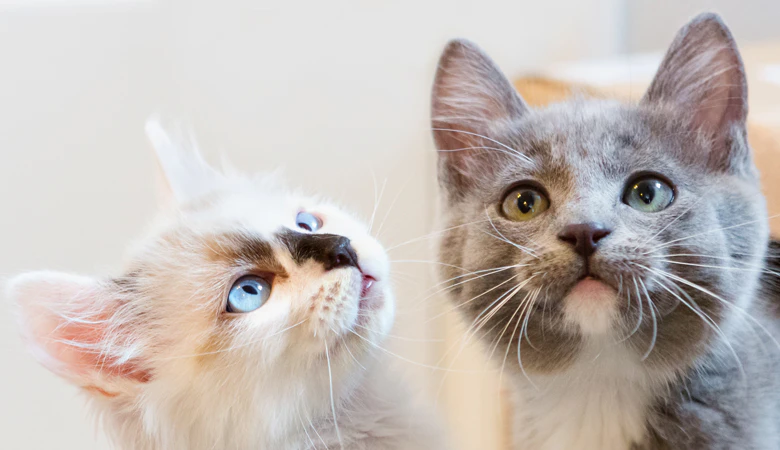
With a solid coat, the cat has the same colour over its entire body. As soon as another colour is visible, the coat is no longer considered solid. A clear example is the Russian Blue, which is known for its uniform blue-grey coat with a silvery sheen.
A bicolour cat has a white coat combined with coloured areas. The amount of white and the location of the coloured areas can vary considerably from cat to cat. In the Ragdoll, for example, bicolour is one of the marking variations that can occur.
Tabby
Tabby is a common coat pattern in cats. There are several variations within this pattern. A mackerel tabby has narrow stripes running from the back towards the belly, while a classic tabby has a broader, marbled pattern. There are also spotted tabbies and ticked tabbies. In a ticked variety, each hair consists of several light and dark bands of colour. This can be seen particularly clearly in the Abyssinian. The Bengal can also have a tabby pattern. The brown tabby has an orange base colour, with the pattern containing various shades.
Tortoiseshell and calico
A tortoiseshell cat, also known as a tortie, has a combination of red and black hairs. With diluted colours, this can become a combination of blue and cream. The colours can be heavily blended or appear in more clearly defined patches. Different tortie variations can be found, for example, in the European Shorthair. When a tortoiseshell pattern is combined with tabby markings, this is also known as torbie.
A calico cat has three colours: red, black and white. These colours can also occur in diluted forms, resulting in blue, cream and white, for example. Both tortoiseshell and calico patterns occur mainly in female cats.
Colourpoint
With a colourpoint coat, the fur is darker on the face, ears, legs and tail than on the rest of the body. The Siamese is a well-known example of a cat with these so-called points. The cooler parts of the body develop more colour, while the warmer parts remain lighter. Colourpoint kittens are born without the characteristic markings. Siamese kittens are also born white, with their colours beginning to develop a few days later. The points then become more distinct as the cat gets older.
Can a cat’s coat colour change?
Yes, a cat’s coat colour can change over the course of its life. In some cats, this is related to the development of the coat. Russian Blue kittens, for example, can temporarily have tabby markings, which disappear at around one year of age. In Ragdolls, on the other hand, the coat becomes progressively darker as they get older, and the final colour only becomes clearly visible after around two years.
Temperature can also affect coat colour. This is particularly noticeable in colourpoint cats. The cooler parts of the body become darker than the warmer parts. As a result, the colour may change slightly depending on the ambient temperature. Sunlight can also play a role. If a Russian Blue is exposed to sunlight for a prolonged period, for example, its normally blue-grey coat may take on a browner colour. A change in coat colour therefore does not always mean that a cat’s genetically determined basic colour is changing. Age and external influences can also cause the coat to look different over time.
Discover everything you need for your cat’s coat care
Whether your cat has a solid, tabby or multicoloured coat, every coat needs suitable care. Regular brushing and the use of appropriate grooming products help keep the coat healthy and preserve its natural colour and shine as much as possible. Are you looking for products to care for your cat’s coat? At Vetsend, you will find an extensive range of brushes, combs and other coat care products for different coat types and needs.