Service
Basket
Menu
Up to 50% off during Purina Week! Read more

When should you call the farrier?

Written by Carmen | Paraveterinair |

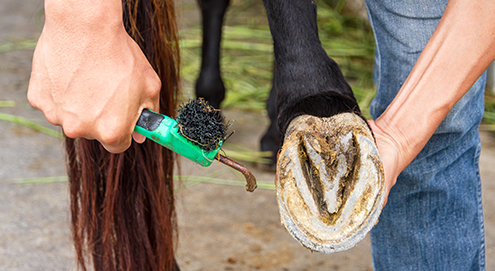
Good hoof care is important for a horse's comfort and freedom of movement. The hooves have to cope with a lot every day due to strain, ground surface and weather conditions. Regular checks help to identify problems in time. But when is it time to call the farrier? In this blog, you can read what to look out for and how to care for your horse's hooves.
Why hoof care is so important

The hoof protects the structures inside the horse’s leg and plays a major role in movement and shock absorption. When a hoof becomes unbalanced, this can affect the entire musculoskeletal system.

Factors such as:

  • nutrition
  • ground surface
  • moisture
  • exercise
  • and hereditary predisposition

can all influence the quality of the hooves.

How often should a farrier visit?

On average, most horses see a farrier every 6 to 8 weeks. Some horses need maintenance more often, for example:

  • young growing horses
  • sport horses
  • horses with hoof problems
  • or horses whose hooves grow quickly or crumble

Horses without shoes also need regular trimming.

Signs that it is time to call the farrier

Sometimes it is immediately clear that the hooves need attention. Look out for example for:

  • Dry, crumbly or cracked hooves
  • Long or unevenly growing hooves
  • Loose or shifted horseshoes
  • Sensitive walking
  • Bad smell or black spots

When should you contact someone immediately?

Contact a farrier or veterinarian sooner when:

  • a horse suddenly becomes lame
  • a hoof feels warm
  • a deep crack develops
  • a horseshoe is hanging half loose
  • or if you suspect a hoof abscess

Related products

Hoof problems

Problems with the hoof wall

Problems with the hoof wall are common and can have various causes. Horses can suffer from crumbly hooves, cracks or damage to the hoof wall. It is important to identify the underlying cause and have the hoof cared for properly. Supplements containing biotin, for example, can support hoof quality, but often need to be given for a longer period of time.

Laminitis

Laminitis is a serious and painful condition in which the connection between the pedal bone and the hoof wall becomes damaged. Horses often try to shift their weight backwards to reduce the pain. Possible causes include nutrition, hormonal conditions such as Cushing’s or overloading one leg.

Thrush

With thrush, the frog of the hoof becomes inflamed due to bacteria. This is more common in wet, dirty conditions or with insufficient hoof care. The frog can become soft and smell unpleasant. Cavalor Dry Feet is suitable for drying the sole and frog of the hoof.

Sole abscess or hoof abscess

A hoof abscess is an abscess in the hoof caused by bacteria. This often causes sudden and obvious lameness. A farrier or veterinarian can open the abscess, after which the pressure and pain usually decrease quickly.

White Line Disease (WLD)

White Line Disease (WLD), also known as white line disease, is a condition in which micro-organisms affect the connection between the hoof wall and the living part of the hoof. This creates cavities under the hoof wall that can become filled with crumbly, light brown material. In the early stages, horses often do not yet have pain symptoms or lameness, which means the problem is sometimes only noticed late. Without treatment, the condition can spread further and, in severe cases, affect the stability of the hoof. Regular checks by a farrier are therefore important. Treatment usually consists of removing affected horn and supporting good hoof balance.

Good hoof care starts with regular checks

By regularly checking your horse’s hooves and calling in a farrier in time, you can help prevent many problems. Small changes are often noticed earlier when you take a moment to look at the hooves every day. This helps your horse stay comfortable and move smoothly.

Sign up for the newsletter!

Also read our other blogs

More tips
Team-veterinair_72_footer

About the author

Carmen, Veterinary Nurse at Vetsend

Carmen is a veterinary nurse and an expert in animal health at Vetsend. With her many years of experience, she provides clear and reliable advice to pet owners. She regularly shares informative articles on nutrition, behaviour, and preventive care. Discover Carmen’s tips for a healthy and happy pet on Vetsend.

Read more about Carmen